


Degiro: The broker that offers the best conditions for investing in ETFs

As we know, every broker is a little different. Some of them are suitable for Czech stocks or daytrading. But which one is suitable for ETF investing? One of the hot candidates is Degiro. That's what this review will be about. You will learn everything from fees, to deposit and withdrawal options, or what we can actually invest in here.
Degiro was founded in 2008 in Amsterdam. Since 2013 it has been offering its brokerage services to retail investors. The company is supervised by the Dutch Authority for Financial Markets (AFM) and overseen by De Nederlandsche Bank (DNB). It is also registered with the Financial Conduct Authority (FCA). It offers trading in equities, bonds, options, bonds, mutual funds, warrants and mainly ETFs.
Within this review, I'm going to focus on the things that were a bit of a head scratcher for me at first. Just things that are useful to know when using Degiro. If you're interested in reading about another broker, I can refer you to my review of XTB a few days ago.
Platform
I had no problem navigating the platform when I first logged in. On the black bar on the left, the Market tab is the first one in the screen and open. As we can see, there are charts of various indices as well as winners & losers for the last day. There is also an option to look at a selection of news, but these are in English. In the favourites tab you can see your favourite titles, for which you can see their current trend. In the all-important Portfolio tab, you can see your open positions, which are nicely sorted by asset type. I see the Dividend Entitlement category as a huge plus. Here you can see how much, when and for which position you will receive a dividend. In addition, you can also see the tax withheld. The rest probably doesn't need to be explained.
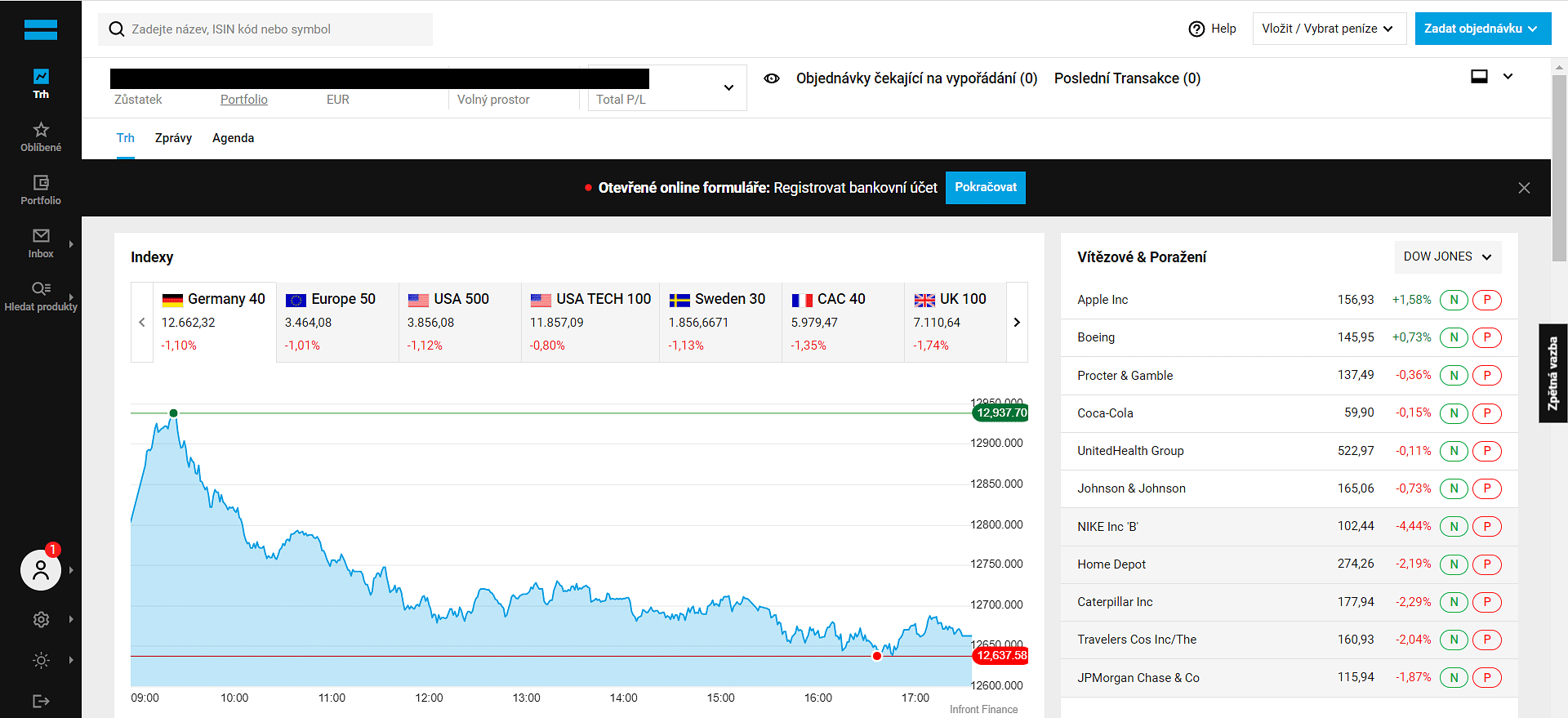
The web interface can also be switched to darkmod.
I see a big advantage in the two-step verification, which, for example, the already reviewed XTB does not offer. Authentication is mediated by Google Authenticator. Authentication in the mobile app, which Degiro also has, is done via fingerprint or PIN.
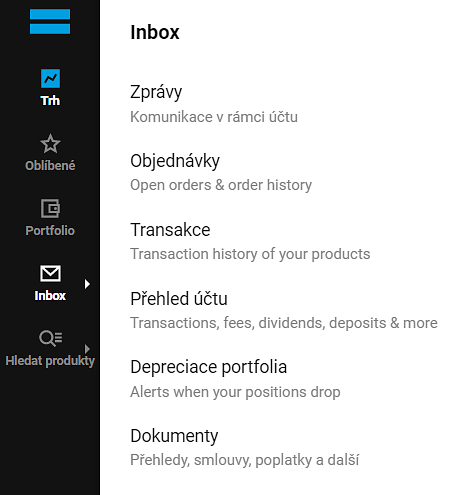
Now let's move on to the slight drawbacks. When we first get a feel for the platform, we notice such an odd mix of English and English. Take a look for yourself at the screen below. The headings in English and some descriptions in English. Customer support should work in Czech anyway, as I found Czech mails on the support site. Service also works by phone.
Another disadvantage is the lack of DEMO account. So if you want to trade on Degir, only with your real money.
At the broker every new investor can choose from 3 profiles, so today it is easier than before when there were 4 profiles to choose from.
Basic - an account for classic stock or ETF trading. In exchange for low fees, the broker can lend out positions held in your securities. This is the type of account we are most interested in.
Custody (not offered) - same functionality as the Basic account. The difference is that the broker does not lend to your third parties. On the other hand, this type of account was (is) subject to higher fees.
Active - access to all instruments Degiro has on offer. In addition to stocks and ETFs, you can trade options, futures and short. It also allows you to trade on margin up to 50% of the portfolio value. As these instruments are very risky, you are required to pass an aptitude test before opening an account.
Trader - same story as the Active account. Allows you to trade on margin up to 100% of the portfolio value.
Trading
One of the things that surprised me was the way to open a position. This is done by placing an order, we have 4 ways here.
Limit order - the most commonly used method. We enter the maximum price we are willing to buy the stock at. We also specify the number of shares. The advantage is that we always know the maximum price we have bought at. If the market price for the trading period is not equal to or less than the maximum price, the trade will not be executed.
Market order - we enter only the number of shares we want to buy. The order will be executed at the best price available at the time of settlement. An order can be placed even at the close of the exchange.
Stoploss - this is an order to close a trade at a certain price if its price moves in the wrong direction to avoid further losses. When the market reaches your desired price and you have lost a predefined amount, a Stop Loss order is triggered and automatically closes your position.
Stop-limit - An order to buy or sell a stock that combines the features of a stop order and a limit order. When the stop price is reached, the stop-limit order becomes a limit order, which will be executed at a set (or better) price.
Deposit and withdrawal
At several brokers, we have experienced a variety of deposit and withdrawal options. But with Degiro it is simple, the only option is bank transfer. The bank account must be under the same name as the one at Degiro. We transfer Czech crowns to the account of the Czech branch of Deutsche bank.
What happens to the money after I deposit it with the broker? Degiro will automatically create a bank account with flatexDegiro after the account is created. All our uninvested money will then be deposited in a separate personal bank account. It is from this that the insurance of funds up to € 100,000 lying in this account then follows.
An indisputable plus is that deposits and withdrawals have no limits, i.e. no minimum amounts. At the same time, both deposits and withdrawals are fully exempt from fees. If you are even more interested in this issue, the Investment Potato summarizes everything well.
https://www.youtube.com/watch?v=U1Rd7n6AUH0&t=644s&ab_channel=Investi%C4%8Dn%C3%ADbrambora
Fees
I'm going to base this on the fee summary that was last updated this month, so this is really fresh information.
Let's start with the fees within the exchanges. Based on this screen shot, you might think that stocks traded on the US and Canadian exchanges, for example, are completely free. However, this is not entirely the case. In fact, in the note below the table, we can see that in addition to the zero commission, there is a €1 manimulation commission. The same loop applies to the Prague exchange, in the table we see a commission of 20 €, but the handling fee is another 20 €, so the total fee for the purchase is 40 €. It is the same for other European stocks, where we have to add the handling fee of €1 to the above fees. So I strongly recommend that you find out which stock exchange you are buying on and what fees apply there.
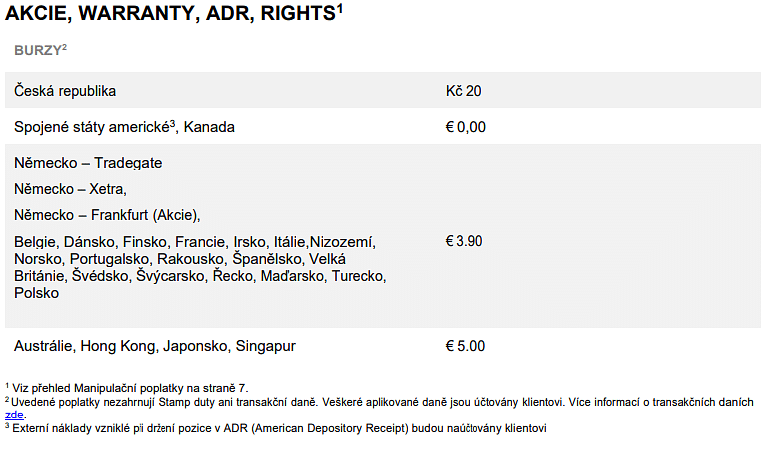
Source: degiro.cz
In addition to these trading fees, Degiro also charges a fee for currency conversions. As we have already mentioned, the conversion from Czech crowns to euros and vice versa is free of charge. It is another thing to convert from euros to dollars, for example. This is charged 0.25% in case of automatic conversion and 0.25% + 10 € in case of manual conversion.
Degiro compensates for these fees by the absence of an inactivity fee and the aforementioned zero fees for deposits and withdrawals. Plus, we're only now getting to the good stuff.
The biggest advantage
The alpha and omega of using this broker is ETFs, not just for me. These can be purchased completely free of fees under certain conditions. What condition is that? Our chosen ETF must be on Degiro's list of fee-free ETFs. So if you want to invest in the widely known S&P 500 index through ETFs, there's nothing easier than to look them up here and then copy the ETF name or ISIN code into the platform's search engine and you're done.
Dividends and fractional shares
Degiro offers the standard W8BEN form, which avoids 30% taxation on your dividend and only withholds 15%. You can also buy Czech stocks on the platform, among others, but they are taxed at 35%. There is the same problem as with XTB. So I recommend generally buying Czech shares elsewhere, or you can go the way of @otakalas, who wrote about it in the discussion under the XTB review, which you can find a link to at the beginning of the article.
If you look for fractional shares in Degir, you won't get anywhere. According to available information, they are not even being considered.
Pros
+ very convenient purchases of selected ETFs +
friendly non-trading fees +
favorable mid-cash rate CZK/€+
wide selection of instruments
Cons
- one deposit/withdrawal method-
35% taxation on Czech stocks-
does not offer fractional shares
This is how I would see the main pros and cons of Degiro. If you have anything to add, or if anything is not clear to you, I would be glad for feedback.
Acest articol a fost scris și verificat în conformitate cu standardele editoriale Bulios.
Urmăriți Bulios pe Google News
Fiți printre primii care află despre noi analize, știri și mișcări pe piețe.
Articole recomandate

 BLACK
BLACK BLACK
BLACK